Changdu Bio · CD BIOENG. & THERAPY
Printing Health for Life: Bioprinted Tumor Organoid Drug Sensitivity Testing
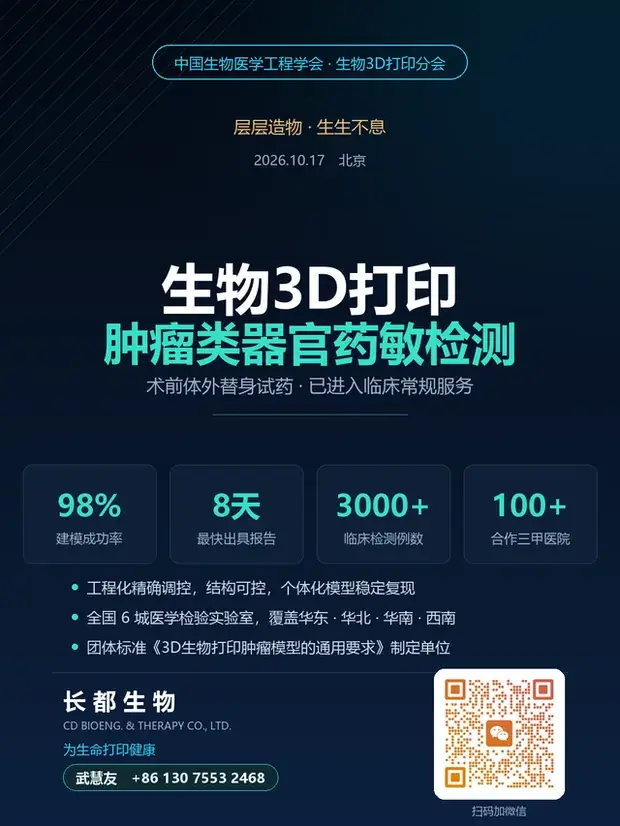
Using a patient's own tumor cells to print three-dimensional organoid models, testing drugs outside the patient's body on their behalf. Engineered precision control with controllable structure turns "preoperative in vitro stand-in drug testing" from research papers into a routine clinical service.
Core Metrics
Four Sets of Numbers Already Proven
Technical Approach
Bioprinted Organoids vs. Traditional Organoids
Laboratories
National Medical Laboratory Layout
| City | Location | Scale | Status |
|---|---|---|---|
| Beijing | Dongcheng District core urban area | Approx. 1,200 sqm | Completed |
| Shanghai | Fenglin Life Health Industrial Park, Xuhui District (adjacent to Fudan Cancer Center and Zhongshan Hospital) | Approx. 1,300 sqm | Completed |
| Ningbo | Xiaogang, Beilun District (Phase II located in Haier Shi's industrial park under construction) | Phase I nearly 1,000 sqm, Phase II approx. 2,000 sqm | Completed |
| Chengdu | West China Health Valley (industrial park in deep cooperation with West China Hospital) | Approx. 1,200 sqm | Under construction |
| Zhengzhou | Central urban commercial area, adjacent to the First Affiliated Hospital of Zhengzhou University, Henan Provincial People's Hospital, and Henan Cancer Hospital | Approx. 1,500 sqm | Under construction |
| Guangzhou | Liuhua Center (former Canton Fair site, reaching ASEAN countries) | Approx. 2,500 sqm | Site selection in progress |
Team
Who Is Behind This
Qualifications
Standards and Projects
Research Directions
Where the Platform Is Extending
FAQ
Four Questions Most Asked by Clinical and Research Partners
What clinical problem does this test solve?
Before a patient officially starts medication, their own tumor cells are used to construct organoid models in vitro and test multiple drug regimens, providing reference for clinical selection — what is called "preoperative in vitro stand-in drug testing."
What sample is needed? How long for results?
Typically tumor tissue obtained from surgery or biopsy. After process standardization, reports can be issued in as fast as 8 days; actual turnaround depends on sample conditions and test items. Please confirm with the laboratory before sending samples.
How is this different from traditional organoid methods?
The traditional approach is closer to natural growth with greater batch variation; bioprinting program-controls printing paths, cell distribution, and matrix structure, achieving controllable and reproducible structures with a modeling success rate of about 98%.
Can we collaborate on research projects?
Yes. The company has long-term joint research with teams from PUMCH, Tsinghua, and other institutions, and also undertakes model construction and drug screening collaborations with hospitals and pharmaceutical companies. Please contact us directly for specific directions and scheduling.
For clinical collaboration, sample submission, and research projects, contact us directly
Wu Huiyou +86 130 7553 2468 (WeChat same number, scan code to add)
Contact
Clinical collaboration / sample submission / research projects
武慧友
CD BIOENG. & THERAPY CO., LTD.
Same number on WeChat. Call directly, or scan the code to add us.